 Ultimate guide
Standardizing Peptide Research Protocols in 2026
Last Updated: November 24, 2026
Quick Summary
Standardizing peptide research protocols means recording every decision that could change an outcome, including dose basis, solvent, storage history, and lot identity. Labs that use a fixed template with structured fields can reproduce each other's work and interpret real differences between studies.
- State whether dose refers to net peptide content or gross lyophilized mass, and report the correction factor.
- Record solvent, volume, and final concentration for every reconstituted vial.
- Log storage temperature and maximum time at each stage, including any excursions.
- Confirm identity by mass spectrometry and purity by HPLC, with method conditions recorded.
- Version each protocol and log changes so earlier results remain interpretable.
Table of Contents
- Why Peptide Research Protocols Vary Between Laboratories
- What a Standardized Peptide Research Protocol Template Should Include
- Dosing Schedules, Dose Definition and Administration Reporting
- Reconstitution, Storage and Handling Guidelines for Peptides
- Peptide Purity Testing Methods: HPLC, Mass Spectrometry and Fill Verification
- Reading a Certificate of Analysis: Evidence Grading and Data Quality
- Comparing Peptide Supplier Quality: A Practical Framework
- Inter-Laboratory Reproducibility, Validation and Protocol Versioning
- Your Next Step: Adopting a Standard Protocol in Your Lab
- Frequently Asked Questions
Why Peptide Research Protocols Vary Between Laboratories
Hoosier Peptides supplies lyophilized, argon-flushed research peptides, and we see the same problem repeated across our customers' labs: two groups order the same compound, run the same assay, and report different results. Standardizing peptide research protocols in 2026 starts with understanding why that happens.
Protocols diverge for ordinary reasons. Each lab may develop its own reconstitution solvent, concentration basis, and dosing unit.
A common source of variation is the difference between gross weight and net peptide content.
Other variables compound the problem:
- Solvent and buffer choice, including pH and salt concentration
- Storage temperature history before and after reconstitution
- Vial headspace and whether the vial was argon-flushed or air-exposed
When these details go unrecorded, a reader cannot tell whether a discrepancy reflects biology or method. Standardization does not eliminate biological variability, but it removes the procedural variability that is entirely within a lab's control.
What a Standardized Peptide Research Protocol Template Should Include
A useful peptide research protocol template records every decision that could change an outcome. The goal is that a competent scientist, given only the protocol, can repeat the work.
At minimum, a template should capture the peptide identity (sequence, lot number, and manufacturer), the net peptide content and how it was used to calculate dose, the reconstitution solvent and final concentration, storage conditions at each stage, the dosing schedule and administration route, and the outcome measures with their acceptance criteria.
Sections should be defined in advance rather than written freely for each study. A fixed structure makes protocols comparable across labs and makes gaps obvious during peer review.
Minimum reporting checklist and machine-readable fields
Free-text protocols are difficult to compare at scale. Recording key fields as structured values allows labs to search, aggregate, and audit protocols automatically. Consider this minimum checklist:
- Peptide sequence and name, with a unique identifier
- Lot number and certificate of analysis reference
- Net peptide content (percentage) and the dose basis (net or gross)
Storing these as discrete fields, rather than prose, is what makes a protocol database useful. Teams can then filter, compare, and flag protocols that deviate from an agreed standard.
Dosing Schedules, Dose Definition and Administration Reporting
Dose definition is the most frequent point of confusion in peptide studies. Before comparing dosing schedules across studies, a reader needs to know what "dose" refers to.
State the dose basis explicitly. A dose expressed as net peptide, corrected for net peptide content, is not interchangeable with one expressed as gross lyophilized mass.
Administration frequency should be reported as a schedule, not a summary.
Reconstitution, Storage and Handling Guidelines for Peptides
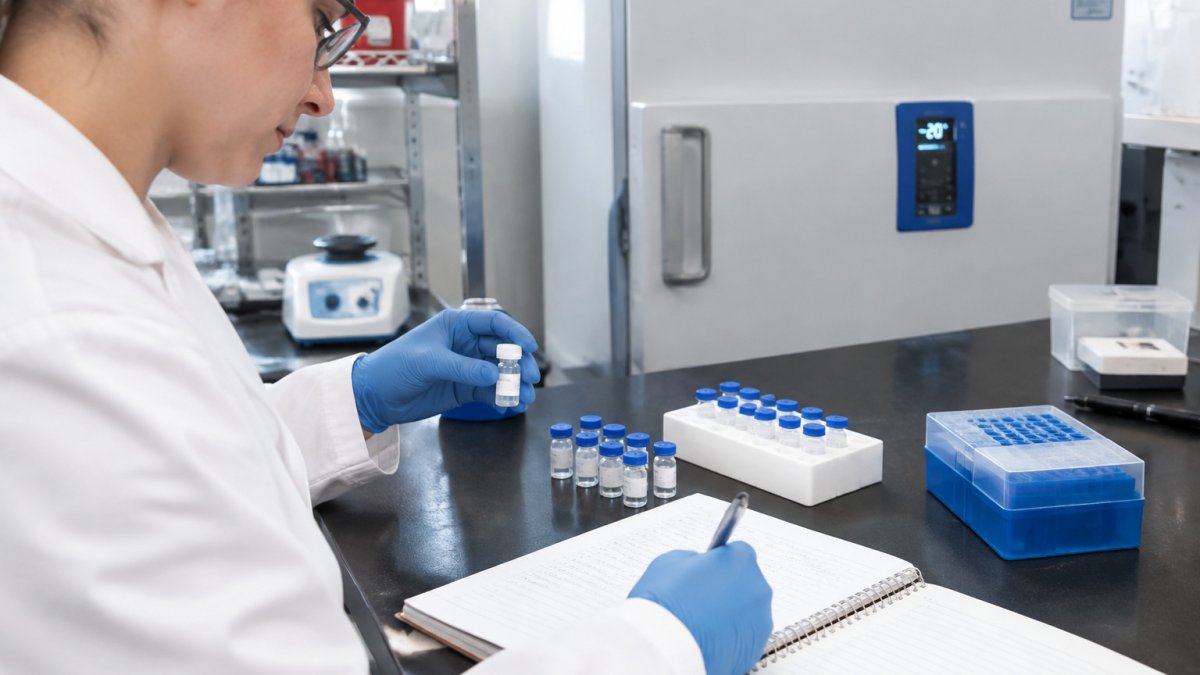
Reconstitution and storage are where many reproducibility problems begin. A peptide that degrades, aggregates, or adsorbs to surfaces before the first dose will produce data that no protocol can rescue. The goal of this section is to turn handling into a set of recorded, repeatable decisions rather than bench habits.
Solvent selection and concentration basis
Record the reconstitution solvent, the volume added, and the resulting concentration for every vial. The solvent choice is not neutral: it changes solubility, aggregation behavior, and the apparent potency of the preparation.
- Sterile water for injection is the default for many hydrophilic peptides and is the least likely to introduce excipient effects.
- Phosphate-buffered saline or other physiological buffers are common when pH stability or ionic strength matters, but the buffer itself can interact with the assay.
- Dilute acetic acid (commonly around 0.1% to 1% v/v) is used for peptides that are poorly soluble at neutral pH, but the acid must be accounted for in the final dosing solution.
State the concentration basis explicitly. A concentration expressed as net peptide is not interchangeable with one expressed as gross lyophilized mass.
Watch out: a peptide that dissolves clear can still be aggregated.
Stability mechanisms and storage conditions
The main degradation routes for research peptides are hydrolysis, oxidation, deamidation, and aggregation. Each has a handling implication:
- Hydrolysis is accelerated by water and by extremes of pH, which is why lyophilized powder is more stable than solution and why reconstituted material should be used within the window stated by the supplier.
- Oxidation affects methionine, cysteine, tryptophan, and histidine residues. Argon or nitrogen flushing of the vial headspace reduces oxygen exposure, and light protection reduces photo-oxidation.
- Deamidation of asparagine and glutamine residues is pH- and temperature-dependent, so storage temperature history should be logged rather than assumed.
Store lyophilized vials cold and dry, protected from light, and avoid repeated temperature cycling. Once reconstituted, follow the storage limits stated in the certificate of analysis or supplier documentation, and log any excursion outside those limits with its duration and the corrective action taken.
Handling workflow and aliquoting
A practical handling workflow records the following at each stage:
- Receipt: record lot number, arrival condition, and storage location.
- Reconstitution: record solvent, volume, concentration basis, date, and time.
- Aliquoting: divide reconstituted material into single-use aliquots where the protocol allows, so that a single freeze-thaw cycle is not repeated across an entire study.
- Use: record the time between reconstitution and administration or assay.
- Disposal: record remaining volume and disposal date.
Argon-flushing the headspace of a vial reduces oxidation during storage, which is one reason lot-level handling matters. Labs should avoid repeatedly opening a vial and should minimize the number of entries into each container.
Container and adsorption effects
Peptides can adsorb to plastic and glass surfaces, particularly at low concentrations. The effect is concentration-dependent and can silently reduce the delivered dose. Record the container type (polypropylene versus glass), any low-binding treatment, and whether a carrier protein was added. Where adsorption is a concern, the protocol should state the minimum concentration used and the rationale.
Recording handling as structured fields
Handling details belong in the same structured record as the rest of the protocol. At minimum, capture solvent, volume, concentration basis, storage temperature at each stage, maximum time at each stage, container type, and any excursion. Storing these as discrete fields rather than prose is what makes a protocol database useful and lets a reviewer compare handling across studies without reading every narrative.
Peptide Purity Testing Methods: HPLC, Mass Spectrometry and Fill Verification
Purity and identity are separate questions, and a protocol should document both. High-performance liquid chromatography (HPLC) measures how much of the material is the target peptide relative to impurities.
Fill verification addresses a third question: whether the vial contains the quantity stated on its label.
When reviewing purity data, check the chromatographic conditions, the detection wavelength, and the integration method, since these change reported purity.
Reading a Certificate of Analysis: Evidence Grading and Data Quality
A certificate of analysis (CoA) is the primary record linking a vial to its tested properties. Reading one critically is part of standardizing your protocol.
Confirm that the CoA references the specific lot you received, not a generic product page.
Evidence grading helps here. Distinguish between primary analytical data (the raw chromatogram or spectrum) and summary statements (a single purity figure).
Comparing Peptide Supplier Quality: A Practical Framework
Choosing a supplier is a protocol decision, because supplier variation becomes data variation. The table below summarizes what to compare when evaluating current practice against a standardized approach.
| Criterion | Typical current practice | Standardized approach |
|---|---|---|
| Dose basis | Gross weight or unstated | Net peptide content, stated explicitly |
| Identity check | Single method or none listed | Mass spectrometry, with observed and expected mass |
| Purity method | Percentage only | HPLC with method conditions recorded |
| Lot traceability | Product-level documentation | Lot-specific CoA linked in the protocol |
| Storage record | Assumed | Logged temperature history |
Hoosier Peptides provides a certificate of analysis with every order and releases lots against HPLC and mass-spectrometry identity criteria. Pricing depends on quantity, dates, and delivery, so request a current quote from our website.
Inter-Laboratory Reproducibility, Validation and Protocol Versioning
A protocol that works in one lab has not yet been shown to be reproducible. Inter-laboratory validation tests whether independent groups, using the same protocol and comparable peptides, reach consistent outcomes within an agreed tolerance. This section turns that idea into a practical framework that connects study design, controls, measurement, and reporting.
Sources of between-lab variation
Before designing a validation, name the sources of variation you are trying to control. A common pattern is to group them into four tiers:
- Material: peptide lot, net peptide content, counterion and water content, purity profile, and storage history.
- Preparation: solvent, concentration basis, reconstitution time, aliquoting, and container type.
- Biological model: species, strain, sex, age, housing, diet, and acclimation period.
- Measurement: assay platform, calibration, operator, timing of sampling, and data-reduction method.
Each tier should have an owner and a recorded value. A validation that controls material and preparation but leaves measurement unstandardized will still show between-lab scatter, and the scatter will be misattributed to biology.
Designing a ring trial or independent replication
A ring trial assigns the same protocol and comparable material to several laboratories and compares outcomes against pre-specified acceptance criteria. A practical design includes:
- A written protocol with a version number distributed to every participating lab.
- A common material source or, where that is not possible, lot-level characterization sufficient to compare net content and purity.
- A shared measurement standard, such as a common calibrant, a common assay kit lot, or a central analysis of raw data.
- Pre-specified acceptance criteria for dose accuracy, purity, and outcome variance.
- A deviation log so that departures from protocol are visible rather than buried in results.
Set acceptance criteria before running the comparison. Pre-specifying thresholds prevents them from being adjusted after the data are in, which is the most common way a validation loses its evidentiary value.
Statistical and data-quality standards
Reproducibility claims are only as strong as the statistics behind them. A standardized protocol should carry a short statistical section covering:
- Pre-registration of the primary outcome and analysis plan, where the journal or institution supports it.
- Sample-size rationale, stated in advance rather than justified after the fact.
- Controls, including vehicle, positive, and negative controls as appropriate to the model.
- Missing-data handling, with the rule stated before data collection.
A common pattern is to report means without dispersion and p-values without effect sizes. Both make cross-lab comparison difficult because a reader cannot tell whether a difference is large or merely statistically detectable.
Protocol versioning and change control
Versioning matters because protocols evolve. Assign each protocol a version number, record what changed and why, and retain prior versions so that earlier studies can still be interpreted correctly.
A lightweight change-control record includes the version, date, description of the change, rationale, and the studies affected. Where a change alters dose basis or measurement, the record should state whether earlier results were re-expressed under the new version.
A harmonization framework across studies
The framework that ties these pieces together has four linked layers:
| Layer | What it standardizes | Minimum record |
|---|---|---|
| Study design | Model, controls, sample size, endpoints | Pre-registered plan with rationale |
| Material and preparation | Peptide identity, net content, solvent, storage | Lot-specific fields linked to the protocol |
| Measurement | Assay platform, calibration, timing | Method conditions and raw data reference |
| Reporting | Structured fields, deviations, uncertainty | Machine-readable protocol record |
When all four layers are recorded, a reader can compare studies without guessing which differences are biological and which are procedural. That is the practical payoff of standardization: not identical results, but interpretable differences.
Evidence tiers for reproducibility claims
Not every reproducibility claim carries the same weight. Separate them explicitly:
- Primary analytical evidence: raw chromatograms, spectra, and lot-specific certificates of analysis.
- Preclinical replication: independent laboratory reproduction of a defined protocol in a model system.
- Clinical evidence: findings from controlled human studies, which should not be inferred from preclinical replication.
- Informal or consumer-facing claims: protocol material circulated outside a research context, which should be labeled as such.
Keeping these tiers distinct prevents a preclinical replication from being read as clinical evidence, and prevents consumer-facing material from borrowing the authority of a laboratory protocol.
Your Next Step: Adopting a Standard Protocol in Your Lab
Standardizing peptide research protocols in 2026 is achievable with a few deliberate steps: adopt a fixed template, record dose basis and storage history for every vial, read each certificate of analysis against its lot, and version your protocols so that changes stay traceable.
When you are ready to source documented peptides for your protocol, visit Hoosier Peptides' website to review current products and request a quote.
Frequently Asked Questions
What should a standardized peptide research protocol include?
A standardized peptide research protocol should identify the peptide by name, sequence, lot number and supplier, and state the purity and identity data used. It should define the dose in both mass and molar terms, the dosing schedule and administration route, the reconstitution solvent and concentration, and the storage conditions from receipt through use. It should also record the study design, controls, measurement methods and any deviations. Recording these fields in a consistent order lets another lab repeat the work or compare results across studies.
How can researchers improve reproducibility in peptide experiments?
Reproducibility improves when every variable that affects the peptide is controlled and documented. Use lots with a certificate of analysis that matches the vial in hand, verify identity and purity on receipt where possible, and keep storage logs for temperature and moisture exposure. Use the same reconstitution method and single-use aliquots to avoid repeated freeze-thaw cycles. Report the lot number in every publication so others can trace the material used.
What information should a peptide certificate of analysis include?
A certificate of analysis should list the peptide name, lot number, molecular formula and molecular weight, and the analytical methods used. It should report HPLC purity as a percentage, mass spectrometry results confirming identity against the expected mass, and the date of testing. Look for the testing laboratory's name, the analyst's sign-off and a statement of the fill quantity or net content. Confirm that the lot number printed on the certificate matches the label on your vial before you accept the material into your inventory.
What analytical methods are used to assess peptide identity and purity?
High-performance liquid chromatography (HPLC) is the standard method for purity, separating the target peptide from related impurities and reporting the main peak as a percentage of total area. Mass spectrometry confirms identity by measuring the molecular mass against the theoretical value. Amino acid analysis or peptide content testing can determine net peptide content, which differs from gross weight because of water and counterions. Using both chromatographic and mass-based methods gives a more complete picture than either alone.
How should researchers document peptide storage and handling?
Document the storage temperature, container type, light protection and atmosphere for each lot from the day it arrives. Lyophilized peptides are commonly stored frozen in sealed vials, and many labs flush headspace with an inert gas to limit oxidation. Record each time a vial is opened, the reconstitution date, the solvent used and the aliquot schedule. Keep these records with the lot's certificate of analysis so that any later variation in results can be traced to handling rather than guessed at.
How can researchers compare peptide suppliers for research quality?
Compare suppliers on documentation rather than marketing claims. Check whether each lot ships with a certificate of analysis that reports HPLC purity and mass spectrometry identity, whether the testing is traceable to a specific lot, and whether the supplier states that products are for research use only. Ask about fill verification, storage and packaging practices, and the process for handling a degraded or mislabeled shipment. A written, consistent answer to these questions is a useful indicator of quality control.
Why do peptide research results vary between laboratories?
Results often differ because labs use different lots, purity levels, net peptide content assumptions, reconstitution methods and storage histories, and because protocols omit these details. Differences in assay design, instrument calibration and data analysis also contribute. Standardizing the reporting fields and validating key measurements across labs reduces these sources of variation, making it easier to determine whether a difference reflects the biology or the methods.
How can researchers create a peptide protocol template?
Start with the minimum reporting fields: peptide identity, lot and supplier, purity and identity data, dose and schedule, reconstitution and storage, study design, and measurement methods. Organize these as fixed sections with required entries rather than free text. Version the template, record every change with a date and reason, and have a second researcher review it before use. Store the template in a shared location so that all projects in the lab follow the same structure.
